Loading...
History
From the opening in 1930 to today's modern arena
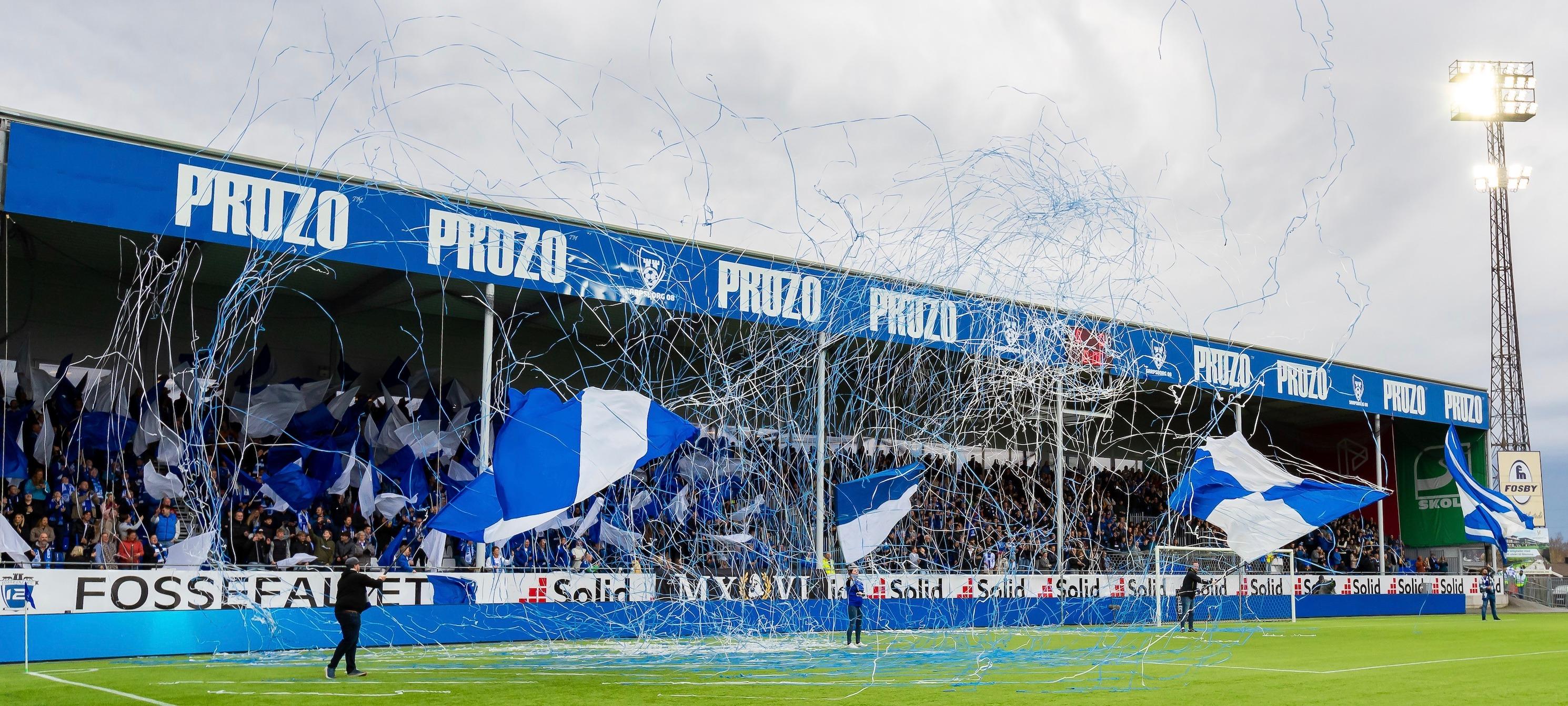
The city's gathering place since 1930
Few Norwegian grounds wear their history as openly as Sarpsborg Stadium. Since 1930 it has been where the city comes together — through cup golds and lean decades, athletics championships and winter ice, all the way to the European nights of the Sarpsborg 08 era. This is the story, decade by decade.
1930
A town builds its arena
Construction took four years and cost roughly 220,000 kroner — serious money in interwar Norway. When the ground was completed in 1930, the opening was celebrated with a B international between Norway and Sweden, a statement fixture for a proud football town. The location has always been part of the charm: the stadium sits in the Enenda district, some 700 metres from the town centre, so close that the walk from the shopping streets to the stands takes only minutes.
The 1930s and 40s
A golden age moves in
Sarpsborg FK, founded on 8 May 1903, arrived at the new ground with Norwegian Cup wins from 1917 and 1929 already in the trophy cabinet, and the golden run simply continued. Further cup titles in 1939, 1948, 1949 and 1951 established SFK among the great Norwegian cup sides, with six championships from twelve cup final appearances in all. Club legend Harry Yven collected four cup golds of his own — the first as a 17-year-old in 1929, the last at 37 in 1949.
1945
The record that still stands
On 14 October 1945 the Norwegian Cup final itself came to Sarpsborg Stadium — the second-to-last final ever staged outside Oslo. Fredrikstad and Lyn drew 1-1 in front of around 18,000 spectators, a crowd that remains the ground’s all-time attendance record to this day.
The 1950s and 60s
More than football
The post-war decades showed the venue’s range. The Norwegian athletics championships were held here in both 1954 and 1960, and in earlier times the ground also doubled as a speed-skating rink in winter. The football kept coming too: IL Sparta added another cup title to the city’s collection in 1952, while Sarpsborg FK took league bronze in 1964 and 1965 during a top-flight spell that ran from 1963 to 1972.
The 1970s to the 90s
The quiet years
Then came the long slide. Top-flight football left town, the facilities aged, and capacity was gradually cut to under 3,000. The stadium stayed in everyday use, but its golden era felt a long way off.
The 2000s
One club, one rebuild
Around the turn of the millennium the direction changed. A new main stand with dressing rooms opened in 2000, and the town’s football community began pulling together: a merger project launched in 1999 and formally registered in 2003 grew into a single club for the whole city. When the old giant Sarpsborg FK joined after the 2007 season the circle was complete, and from 2009 the club has carried the name Sarpsborg 08. That same year the pitch was converted to artificial turf and new floodlights were installed.
The 2010s
Back at the top
Sarpsborg 08 won promotion in 2010, went straight back down, and returned in 2012 — this time to stay. The results soon followed: a cup final in 2015 (a 0-2 loss to Rosenborg), another in 2017 (2-3 against Lillestrøm), and above all bronze in the 2017 Eliteserien, the club’s first league medal. The ground grew with the team: the railway-side stand and the main stand were upgraded between 2013 and 2016, and a new 1,500-capacity stand in the Klokkesvingen corner was ready for the 2018 season.
2018
European nights
That bronze medal sent Sarpsborg 08 into the Europa League, and in the autumn of 2018 the old municipal ground hosted nights nobody in the city will forget. ÍBV, St. Gallen, Rijeka and Maccabi Tel Aviv were all knocked out in qualifying, and the group stage brought Beşiktaş, Genk and Malmö FF to Sarpsborg. The home crowd saw a 1-1 draw with Malmö in front of 8,022 — a sell-out and a club record — a dramatic 2-3 defeat to Beşiktaş, and finally a 3-1 victory over Genk.
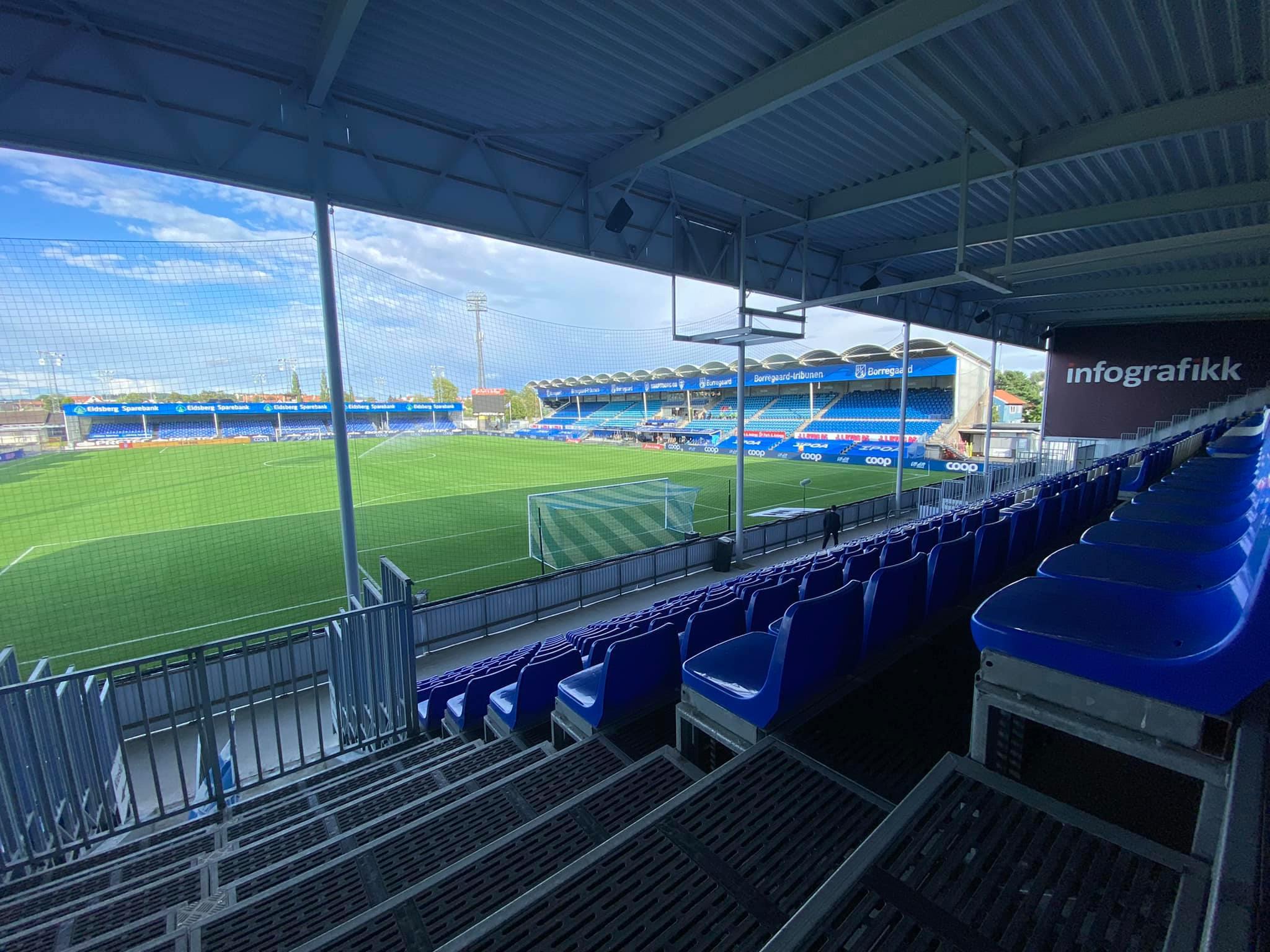
Sarpsborg Stadium today
Today Sarpsborg Stadium holds 8,022 spectators, 2,078 of them seated under the roof of the main stand. Unusually for a Norwegian top-flight venue, it still carries its original name — no sponsor on the facade, simply Sarpsborg Stadium. The same ground that staged a Norway–Sweden fixture in 1930 was hosting Europa League football almost nine decades later, and the city's football story is still being written here.